
Technical challenges at ENGIE: “I never expected to be doing this.”
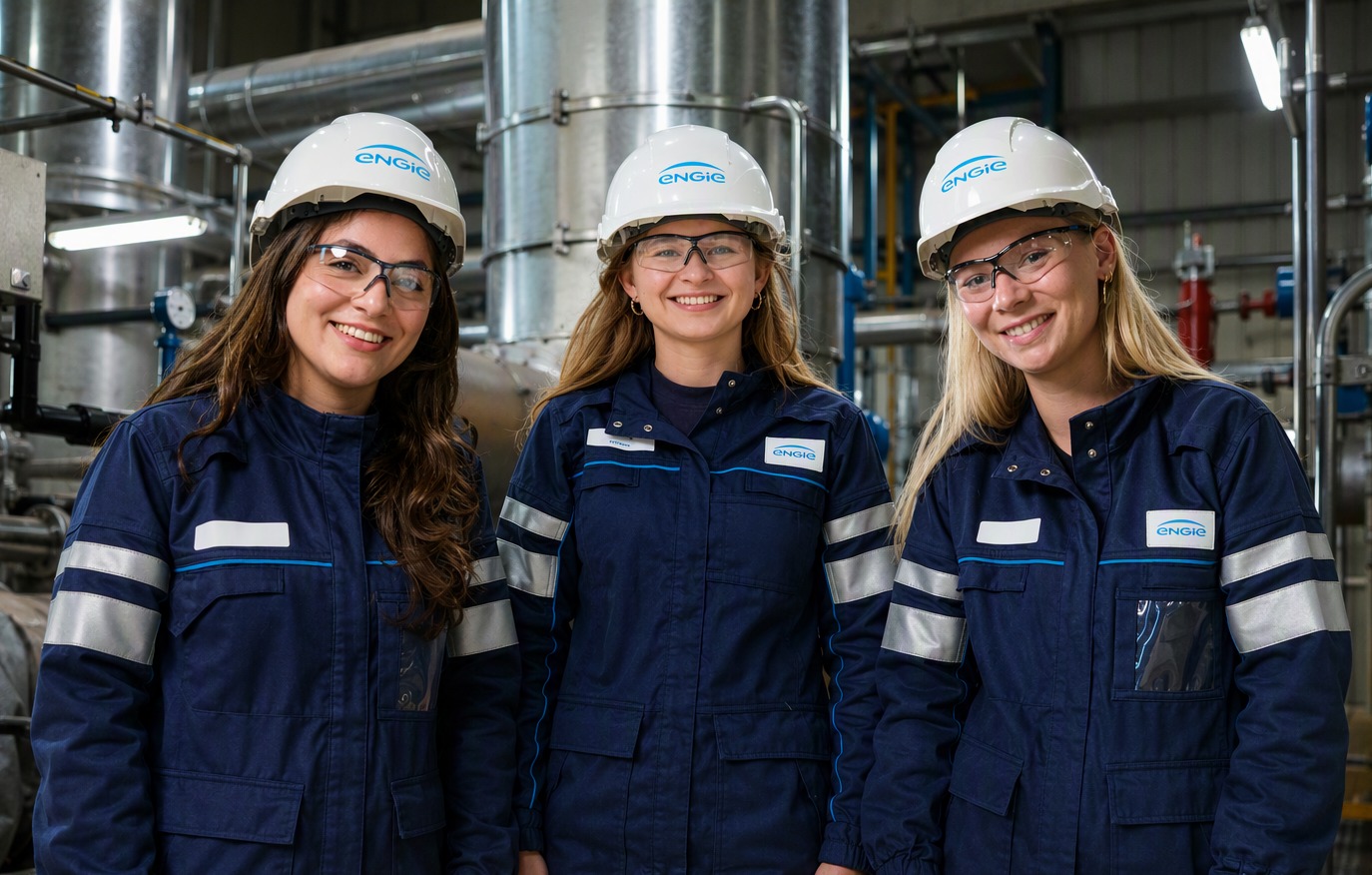
“As a trainee, I was already given a lot of responsibility,” says Monique (25). “I had a good connection with my ‘buddy’, who always made time to explain things. After a few months, I had made great progress in my project.” Today, as an Engineer Operations & Maintenance, Monique is involved in various projects relating to ENGIE’s power plants, as well as, for example, the construction of a brand-new battery park in Drogenbos. And yet she had doubts about applying. As an expat from Brazil, her Dutch was still very much a work in progress. But the tone of the job vacancy convinced her to go for it.
“In ENGIE’s job vacancies, I read that women often only apply when they feel one hundred percent qualified, whereas you do not need to meet every single expectation to be a strong candidate,” Anastasia (28) also explains. “That sentence gave me the confidence to apply, even though the work seemed quite technical and I came from a completely different sector.”
Outside your comfort zone
“In my previous job, I missed having impact and being challenged,” Anastasia continues. “I decided to retrain as a level 2 prevention adviser.” She then ended up at ENGIE rather by chance. “When I started, I was quite nervous. I had the impression that, as a woman, I would have to prove myself even more, but I was pleasantly surprised. During the onboarding period, I got a feel for the organisation and my colleagues. I quickly noticed that everyone was open to all my questions.”
Today, Anastasia works as a Health, Safety & Environment Project Engineer. She supports projects, such as the dismantling of test battery containers, in terms of safety, health and the environment. “It is a job full of variety and challenge. I regularly do things that are far outside my comfort zone. These are things I never thought I would be doing.” Monique adds: “Managers encourage you to seize opportunities and lead projects. That is really great.”
Passionate colleagues
We hear a similar story from Marie (25). With a background in business management, she was interested in the vacancy for Junior Cooperation Manager at ENGIE, but did not feel she was a top candidate. Still, she decided to give it a try because the vacancy emphasised that a technical degree was not required. Today, she is responsible for the day-to-day follow-up of concluded contracts and is also involved in process data management.
She looks back on her start with great warmth. “The colleagues were very open,” she says. “I was allowed to ask anyone questions, and they would take the time to explain things thoroughly. There are many extremely passionate people here who enjoy sharing their knowledge. It was my first job, so I was quite impressed by the complexity and depth of the contracts I had to read. But because I was allowed to ask so many questions, and because everyone was so friendly and easy to approach, I gradually got to grips with it.”
A good culture
Monique is used to being surrounded by male colleagues. She studied technical subjects and did an internship in a truck garage. “That is why it is especially nice to meet a woman at an ENGIE event,” she laughs. But all those male colleagues do not bother her. “They really do not treat you differently because you are a woman. The culture here is good.”
According to Monique, Anastasia and Marie, another major advantage is the flexibility ENGIE employees enjoy. “When I work at a site further away from home, I start early to avoid traffic,” says Anastasia. “When I stay in Ghent, the flexible working hours allow me to enjoy a longer morning.” Monique adds: “There is a lot of understanding if you occasionally deviate from your working hours. If I have a doctor’s appointment or want to go to my 5 p.m. Pilates class, I can leave earlier.”
Challenges today and tomorrow
Monique is looking forward to the delivery of the battery containers at the Drogenbos site in 2027. “Then I will work on site with international colleagues, as lead of the Instrumentation & Control team.” Meanwhile, Anastasia is training to become a level 1 prevention adviser. “I am very grateful for this opportunity to deepen my expertise even further,” she says.
And Marie? She is taking things as they come. “Today, I am independently managing the most recent contract with a major industrial partner, from implementation to daily coordination,” she says. “So this is an exciting and enjoyable period. At the same time, I feel that my managers expect me to grow into a new role in a year or two. They are helping me explore which direction I could take. Should I stay within this team, or choose a completely different business unit? There are many possibilities. That is something to look at more closely from next year onwards.”
© Jobat