
Interview | Monique: From Brazil to Belgium: this young engineer found her place despite the challenges
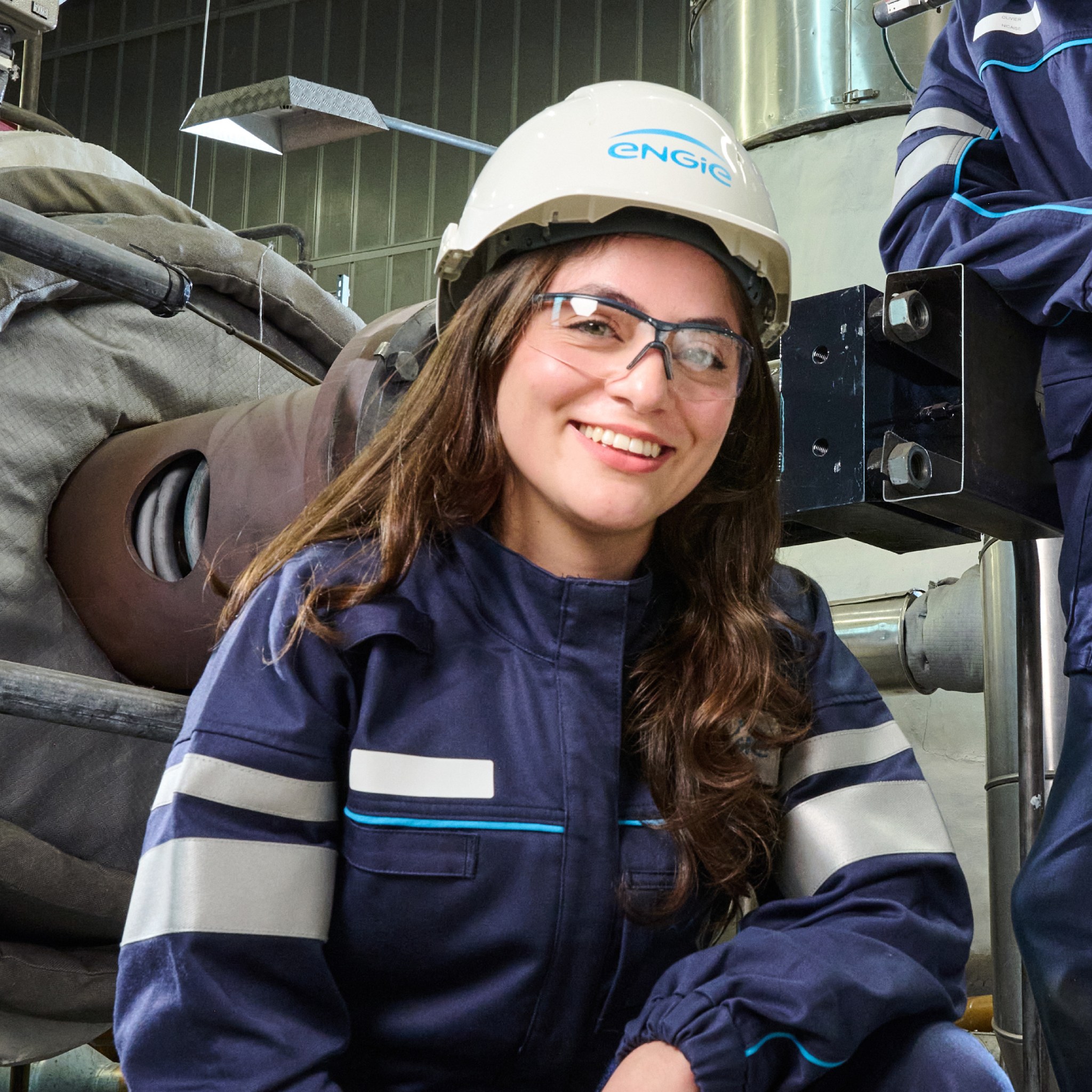
Who can claim to know Telêmaco Borba? “It’s a small town in Paraná, a state in southern Brazil, four hours by car from Curitiba, the state capital,” explains Monique Mainardes, a 25-year-old Brazilian who now works as an engineer at ENGIE in Belgium. It was there, nearly 10,000 kilometres away, that her inspiring journey began...
A small town built around a paper mill
Telêmaco Borba? “That is where I grew up. The entire town was built around a paper mill. Almost everyone had a job directly or indirectly linked to the factory.” As she was about to start secondary school, a new institution was created: the Federal Institute of Paraná. “It is a type of secondary school where you can learn a technical profession. I could become an automation technician. That is where I realised how passionate I was about technology. The logical next step was to continue my studies and become an engineer.” Together with her future husband, she moved to Belgium to study electromechanics at KU Leuven. “Fortunately, the programme was taught in English, and it was the only one available in English. It felt as though it had been created specifically for me.” Because the education system was different, she initially had some catching up to do in mathematics and English.
One of the few women in her field of study
Once she had caught up, Monique was able to fully dedicate herself to her studies. Coming from a distant country was far from being a challenge for her: “Since my degree programme was in English, people came from all over the world. That was never an issue for me.” However, another challenge was very real: “Yes, I was clearly one of the few women. I was studying almost exclusively with men. The more I specialised in electromechanics, the fewer women there were. Most of my female classmates chose electronics, IT or chemistry instead. To give you an idea, by the final year there were only two women left, and we were not even in the same class. It could feel quite lonely.” The young Brazilian also faced sexist remarks, as well as comments about her efforts to learn Dutch, a language some people considered too difficult for someone whose native language is Portuguese. “I also experienced those kinds of comments in Brazil when I worked in a truck garage. ‘Are you sure you want to do this?’ Well, yes. And that experience has always helped me throughout my career.”
A graduate programme...
After completing an initial internship with a company specialising in automation technologies, Monique Mainardes joined an ENGIE graduate programme. “I applied to several companies, but ENGIE contacted me directly. Personally, I really believe in this type of programme because it allows you to join a company and discover different jobs and departments. And on top of that, it was in the field that interested me most: operations and maintenance.” Even before she started, there was an almost instant connection with her manager. “It’s difficult to explain, but you can just feel these things. At ENGIE, the interviews were very natural. It felt more like a discussion about our experiences, our professions and our ambitions. It was completely different from what I had experienced in other companies.” The programme allowed her to discover a wide range of activities and work on several projects, at the Drogenbos power plant, the Vilvoorde power plant and even in the Netherlands, near Groningen.
... and a job full of opportunities
That first experience proved extremely valuable for what came next. “Because, in a way, I was already working towards the position I hold today as a Project Engineer. We are currently building a new battery park in Drogenbos, and I am responsible for the instrumentation and control systems.” More than just a job, Monique also found her place at ENGIE, both as an engineer and as a woman. “It is a fascinating environment, and the company offers many opportunities to grow across different fields and functions.” Monique has also set herself an additional goal: helping to change certain mindsets. “I believe that if I do a good job, I can also help change perceptions of women in technical professions,” she concludes.
© Références